

MY APPROACH (AKA: MY RHINOCEROS STORY)
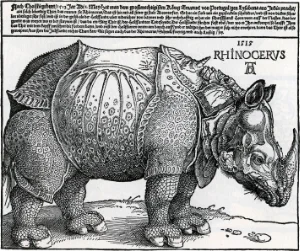
If you took an art history class, you may remember Albrecht Dürer's rhinoceros. Dürer never saw a rhinoceros himself, and never would. In 1515, he was given a written description, secondhand notes from an unknown artist who claimed to have seen an Indian rhinoceros arrive in the port of Lisbon. From those notes alone, Dürer created one of the most reproduced animal images in history: an armored, scaled creature with a small twisted horn on its back. It is almost entirely anatomically wrong. It was copied for two hundred years anyway, and is still considered one of the most influential animal images ever made.
What has always stayed with me isn't the accuracy, it's the opposite. Dürer took an incomplete, secondhand idea and gave it enough form, weight, and conviction that it outlasted the truth. That is closer to what strategy work actually is than most people admit. I rarely start with a complete picture. I start with a rough idea, a set of notes, a half-formed sense of where a business needs to go, and the job is to give that idea enough structure and character that other people can see it, believe it, and act on it.
I came by that instinct honestly. Both of my parents are anthropologists, and I grew up in the back of their lecture halls and classrooms, listening to them and their colleagues work through why people do what they do, what shapes belief, behavior, culture. I didn't realize it at the time, but that early, constant exposure to the discipline of understanding people before explaining them shaped how I still approach every business I work with. Before I touch a brand, a channel, or a strategy, I want to understand the people who make that business function, the customers, the team, the leadership, in the same way Dürer had to build understanding from someone else's careful observation. Strategy that isn't built on real understanding of people is just decoration.
That combination, an anthropologist's instinct for listening and understanding people, an MBA's discipline for structure and numbers, and twenty years of hands-on marketing and go-to-market work, is the lens I've carried into every business I've touched. It's also the lens I bring to newer territory now, like AI enablement, where most organizations are working from an incomplete picture of what's possible and need someone who can translate ambiguity into a real, working plan.
Dürer's rhinoceros is wrong in almost every detail. It's also unforgettable. I think about that trade-off, and about the gap between what we're told and what's actually true, more often than I probably should.




An invitation this week, to join a marketing panel, turns into a great excuse for me to pontificate about digital marketing predications and ideas for 2018